
Zebra Mussels in Memphremagog – What Does That Mean for Seymour?
We’ve recently received some bad news.
Many of you have probably heard about the multiple Aquatic Invasive Species (AIS) that can be found in nearby Lake Memphremagog and that zebra mussels are at the top of the list. Zebra mussels were identified in northern Lake Memphremagog in 2018, but since the flow of water is to the north, their migration into the U.S. waters has been delayed. In a recent press release VTDEC announced the arrival of these organisms in US waters.
While Seymour has been battling invasive species for 25 years (successfully, so far!), the arrival of this harmful species in such close proximity means that we have to increase our vigilance.
The challenge with animal AIS like zebra mussels is that the reproductive parts of their lifecycle (veligers) are microscopic, which makes it impossible to detect during a visual boat inspection, so the mantra is CLEAN, DRAIN, DRY! However, with many aspects of different watercraft ,this isn’t always easy. Regular boat motors take in water while operating to cool the engine, and the water leftover in the engine can contain the microscopic organisms. Hot water over 140 degrees F. is the only known way to eradicate zebra mussels. The Greeter Program at Seymour Lake does have a hot water decontamination station and the greeter station is open every day from Memorial Day weekend to the end of October (no greeter program in the State operates more than we do), but we don’t catch everyone and not every watercraft can be decontaminated.
Why wakeboats could be a concern:
The type of watercraft that poses the biggest decontamination challenge is the wakeboat. Each wakeboat has multiple internal ballasts tanks, which operate in a closed system. If a wakeboat picks up ballast water in Lake Memphremagog, even if they empty their tanks, there is between one and 23 gallons left in the system. One drop of water can contain over 50 organisms that are ready to reproduce! And these organisms have been known to be viable in standing water for up to 30 days.
There are methods to decontaminate wakeboats, but our local greeter station isn’t equipped for that level of operation. VTDEC hopes to have wakeboat decontamination stations available by appointment this summer.
A reminder that in April 2024, Vermont enacted our nation’s most restrictive wakeboat rule, which importantly includes a Home Lake Rule provision. To radically reduce the transport of AIS between lakes, this provision requires every wakeboat owner/user to declare a “home lake” in each calendar year, and stay only on that home lake, or be professionally decontaminated by a DEC-approved decontamination station.
Although DEC staff recently have talked about amending the Wakeboat Rule, the rule as it exists today has the weight of law until/if any changes wend their way through the entire arduous and formal process of the Vermont State Administrative Procedures Act, with final sign-off from the Legislative Committee on Administrative Rules (LCAR).
What’s so bad about zebra mussels?’
There’s a reason why they are called Invasive Species – because they Invade! Zebra mussels tend to fully cover solid substrates, such as rocks and docks. They also like pipes, so if you have any older water systems that pull from the lake, those pipes will eventually become clogged to the point of becoming unusable. There can be up to 100,000 adult organisms in one square foot!
This is a golf ball:
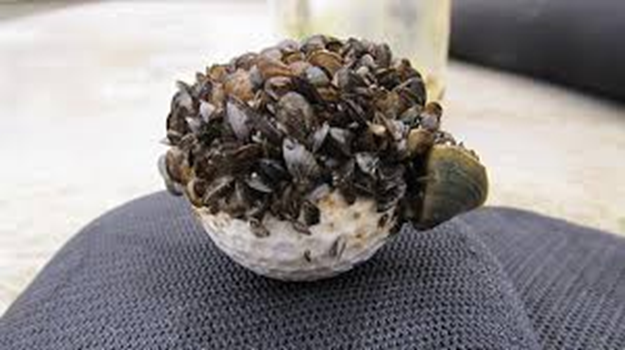
They smother native mussels, clams and crayfish by accumulating on their shells and you really don’t want to walk in bare feet in an area populated area. Additionally, the ecological balance is disrupted because they outcompete the native species for food and space and reproduce very quickly. One female adult zebra mussel can produce approximately 1 million veligers (larvae) in one season!
What do they look like?
Zebra mussels are relatively small (but varied in size, but generally around the size of a dime) striped (hence, the zebra name) and D-shaped.
Once zebra mussels get into your waterbody, there’s no getting rid of them, so prevention is the key. Even one drop o fwater can start an infestation.
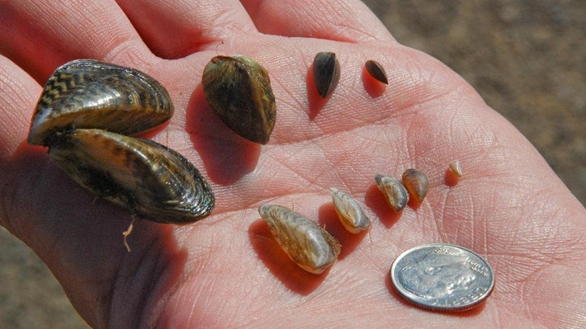
D-shaped and can stand on it’s side:
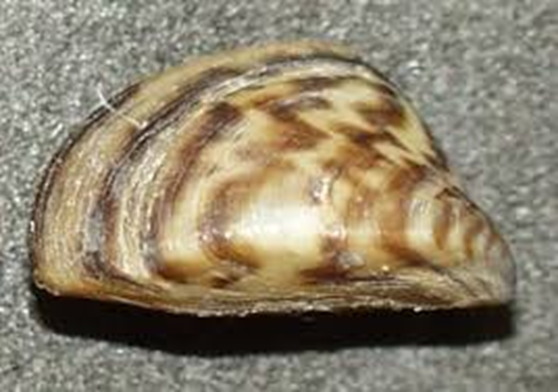
CLEAN, DRAIN, DRY
In Vermont, zebra mussels can be found in Lakes Memphremagog, Champlain, Bomoseen and Dunmore. If your watercraft has been in any of these water bodies this season, please see a greeter at the public access. Regular motors can be decontaminated and the watercraft and equipment will be checked for zebra mussels and decontaminated if necessary. If your watercraft can’t be decontaminated, it’s recommended that you wait at least 30-days to enter a non-impaired waterbody.
If you have a wakeboat, it’s recommended that you either go to a decontamination station or wait to enter Seymour next season. So if you’ve been in Memphremagog or Champlain, don’t come back to Seymour this season!
The identification of zebra mussels in U.S. waters in Lake Memphremagog is very concerning. It only took three years for zebra mussels to migrate from Memphremagog to Lake Massawippi. Seymour doesn’t want to be next!